Camponotus
Camponotus auriventris
Nuptial Flight Calendar
Flight months: Apr, Oct, Nov, Dec
Care Guide
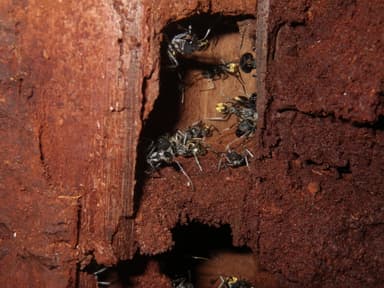
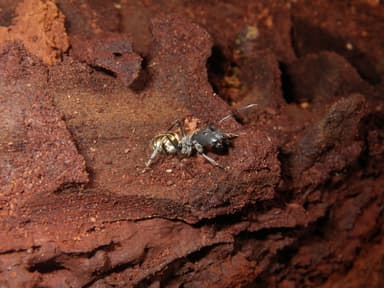
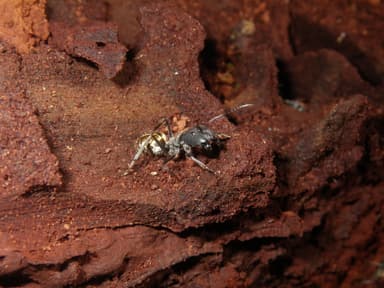
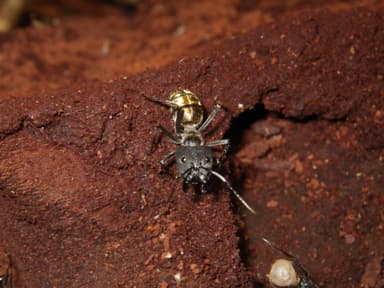
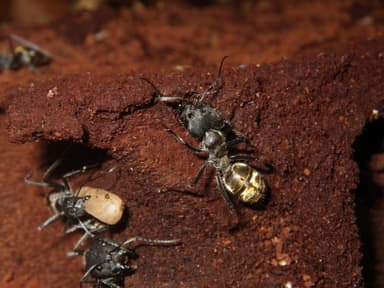
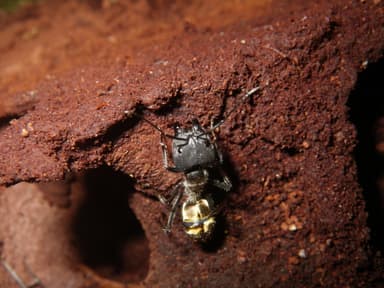
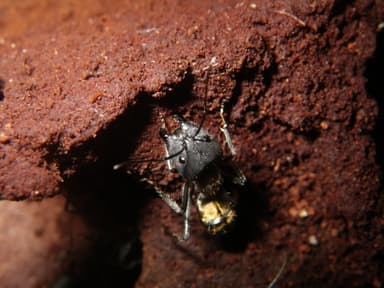
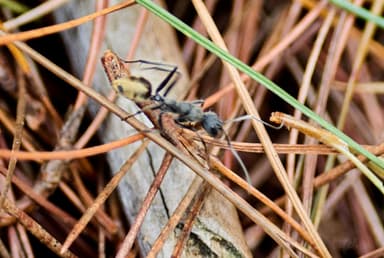
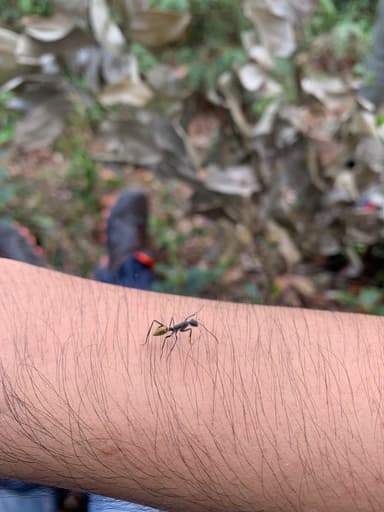
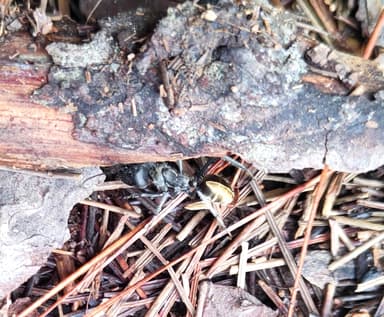
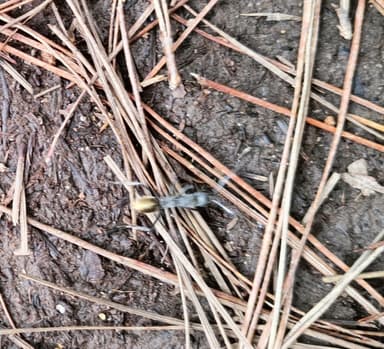
Camponotus auriventris, whose scientific name translates to “golden-bellied,” is a stunningly beautiful carpenter ant that captures the attention of hobbyists who appreciate both form and behavior. The queens are notably robust, measuring 14–17 mm, while workers display a striking polymorphism with minor workers as small as 6 mm and major workers reaching 12 mm, their heads impressively proportioned for defense and food processing (AntWiki; Emery 1889). The species earns its name from the distinctive golden pubescence that adorns the gaster, contrasting with a darker, often reddish-black head and thorax – a shimmering feature best appreciated under soft lighting. Colonies in the wild can grow to several thousand individuals, with captive colonies comfortably reaching populations of up to 10,000 at maturity. They are claustral founders, meaning the queen will seal herself away to raise her first brood using only her wing muscles and fat reserves, a process that requires no external feeding until the first workers emerge. Found across a broad swath of Southeast Asia, from Myanmar down through the Indonesian archipelago and into northern Australia, C. auriventris experiences a consistently warm and humid climate, which directly informs their captive care (GBIF occurrence data).
With an intermediate care difficulty rating, this ant is best suited for keepers who have already mastered the basics of founding and maintaining a small colony, particularly those familiar with tropical species that lack a hibernation cycle. The challenge lies not in erratic behavior or special dietary needs, but in the steadiness required to maintain their environmental parameters and the patience needed during the early founding stages. Because they are polymorphic with two distinct worker castes, observing the colony as minors transition to majors offers a fascinating progression, but it also means the keeper must provide nest spaces that accommodate the large majors without allowing gaps through which smaller workers might escape. Their tropical nature means they will actively forage and raise brood year-round, so you must be prepared for a never-ending cycle of feeding and maintenance. This is not a colony you can simply refrigerate for the winter; instead, they reward consistent care with dynamic activity and intricate social interactions.
Housing C. auriventris requires a nest that can hold a stable microclimate, as they are sensitive to drying out. The ideal temperature range is 22–28°C, which can be easily achieved with a heat mat placed under one portion of the nest, always governed by a thermostat to prevent lethal spikes. Humidity should remain between 50% and 70%, which is relatively moderate and can be maintained using a plaster, ytong, or gypsum nest with a water reservoir, or by regularly misting a naturalistic outworld. Since these are carpenter ants, they will readily excavate wood-like substrates, making a cork-lined or ytong nest particularly appealing, though they also thrive in classic acrylic formicariums. Provide a deep foraging arena with a sand or clay substrate, plenty of climbing opportunities, and a tight-fitting lid because major workers can easily scale smooth surfaces. Their native haunts are warm and often moist, so avoid letting the nest become waterlogged, as this encourages mold and mite issues. A gradient within the nest allows the ants to self-regulate, moving brood to optimal zones.
The dietary needs of C. auriventris follow the typical camponotine pattern of an omnivorous diet split between protein for larval growth and carbohydrates for worker energy. Offer a steady supply of small, pre-killed insects such as crickets, mealworms, or dubia roaches two or three times per week, taking care to remove uneaten remains before they spoil. For carbohydrates, they are enthusiastic drinkers of sugar water, honey diluted with water, or artificial nectar; a small dab of pure honey or a cotton-stuffed liquid feeder works well, but always provide a plain water source separately to prevent drowning. In a thriving colony, minor workers will mainly tend brood and feed, while majors often serve as repletes, storing liquid food in their expanded crops. Fresh water must be constantly available, ideally via a test tube with a cotton plug or a dedicated water tower, as dehydration is a rapid threat in warm setups. During the founding stage, a newly mated queen needs nothing at all until her first workers arrive; feeding her prematurely will only stress her and foul her chamber.
Happily for keepers who love year-round ant activity, C. auriventris does not require hibernation. This species lacks a diapause phase, so you should never artificially lower temperatures to simulate winter. Keep the colony at its usual warm range right through the year, and you will observe continuous brood development and foraging. In their natural range, seasons are defined more by rainfall patterns than by cold, so while you might notice a slight slowdown during drier periods if you mimic such cycles, this is entirely optional. The absence of a required cold period simplifies long-term care dramatically and removes one of the most common pitfalls – the risk of losing a colony to improper hibernation. Just remember that because the ants never rest, you must stay on top of feeding and nest hydration consistently.
The first few days after receiving your C. auriventris queen or founding colony set the tone for a successful relationship. Upon arrival, place the test tube or small nest in a quiet, dark spot at the target temperature and resist the urge to check on her for at least 24–48 hours. She will likely be stressed from transit, and any vibration or light can disrupt her egg-laying. If she arrives with no workers, simply ensure the water in her tube is fresh and leave her completely undisturbed. For a young colony with a handful of workers, you may offer a minuscule drop of sugar water on a slip of aluminum foil just inside the outworld after the first day, but do not introduce insects until you see the workers actively foraging and dragging back liquids – usually by day three or four, a tiny pre-killed fruit fly is enough. Watch for signs of healthy acclimation: the queen should settle into a calm posture, workers will begin grooming and clustering around her, and eggs will appear as tiny white sausages if she hasn’t already laid them. Avoid moving the nest during this fragile period, and maintain high humidity; a stressed Camponotus queen may cannibalize her brood, so the mantra is “patience and peace.” With these foundations in place, your golden-bellied colony will gradually emerge as a showcase of tropical ant splendor.