Pachycondyla
Pachycondyla crassinoda
Nuptial Flight Calendar
Flight months: Jan, Feb, Oct, Nov, Dec
Care Guide
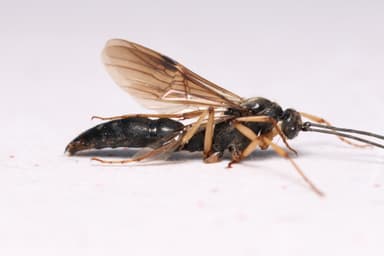
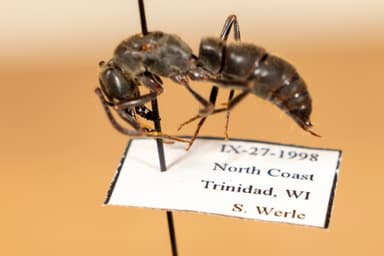
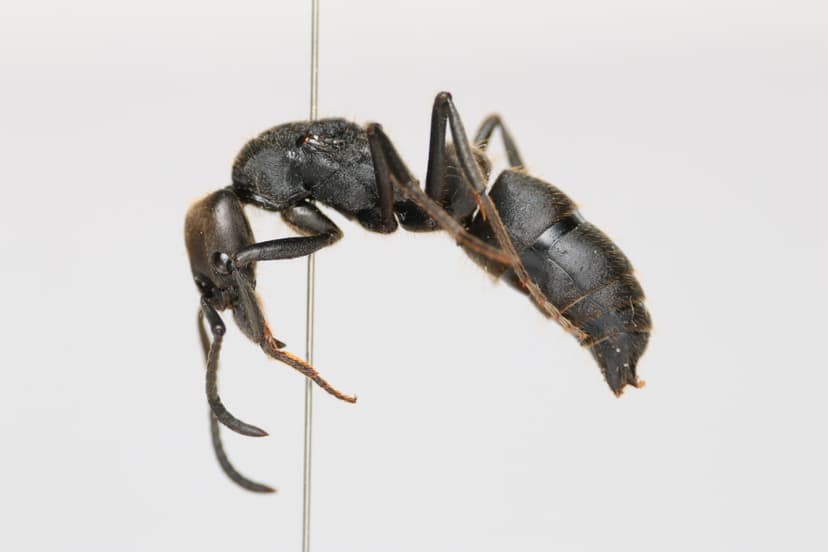
Pachycondyla crassinoda, commonly called the giant thick-knot ant, is a formidable ponerine that stands out as one of the largest ants in the hobby. Queens measure an impressive 18 to 22 millimeters, while workers range from 15 to 20 millimeters, all clad in a glossy, jet-black exoskeleton that emphasizes their robust build. Colonies are small by typical standards, rarely exceeding 200 individuals, and the species is monomorphic, meaning all workers share a single, powerful morph. Native to the Amazon Basin and its fringes, from Colombia and Venezuela south to Bolivia and central Brazil (GBIF occurrence data), these ants inhabit warm, humid lowland forests. Their near-ancestral traits — a potent sting, a fully claustral founding strategy, and a fiercely predaceous lifestyle — offer a rare glimpse into the biology of basal ants (Mackay & Mackay, 2010). For the keeper, the draw is not just sheer size but the dramatic hunting behavior and the deeply fascinating, often overlooked social subtleties of a primitive ponerine society.
This species is unequivocally an expert-level commitment, and it is not a choice to make casually. The demands are steep: the powerful sting, while not medically dangerous to most, is extremely painful and can make routine maintenance an anxiety-inducing task. Their large size and strength necessitate an escape-proof enclosure, as workers can muscle open poorly secured lids or climb smooth surfaces if barriers fail. The tropical microclimate required leaves almost no room for error, and any prolonged deviation in temperature or humidity can rapidly collapse a colony. Pachycondyla crassinoda is therefore suited to the advanced keeper who has already mastered moisture-dependent setups and sensitive species, and who approaches ant-keeping as a patient, observational science rather than a casual pastime. In the right hands, however, the rewards are immense: watching a queen communicate with her workers through antennal taps or seeing a coordinated group subdue a live grasshopper gives a privileged insight into a lineage that predates many modern genera.
Recreating the perpetually muggy forest floor of their Amazon home is the cornerstone of successful housing. The enclosure must be kept at a steady 22 to 28°C with a relative humidity of 70 to 90%, ideally with a slight gradient to allow the ants to self-regulate. A two-part setup is best: a moisture-absorbent nest made of ytong or high-quality plaster, carved with deep chambers and equipped with an externally accessible hydration reservoir, paired with a spacious foraging arena. I strongly recommend adding a natural substrate layer, such as a sand–clay mix or fine coconut coir, to the nest area, which the ants will manipulate to create their own galleries and which dramatically aids humidity retention. The foraging arena needs a very secure, tight-fitting lid, as a PTFE or fluon barrier alone is often insufficient for these large, determined climbers. Ventilation should be minimal to lock in moisture, yet enough to discourage mold. Gentle, thermostat-controlled side heating works well; never use heat lamps that dry the air.
Pachycondyla crassinoda are obligate insectivores with a high metabolism, and feeding them a varied, protein-rich diet is essential. Offer live or freshly pre-killed prey such as crickets, dubia roaches, red runner roaches, and mealworms, with occasional wax moth larvae as a high-energy treat. The hunt is a spectacle: a worker will immobilize prey with its sting and then drag it back to the nest, often assisted by nestmates. Match prey size to the colony’s capacity — a lone founding queen and her first nanitic workers will need pinhead crickets or finely chopped pieces, while a mature colony can tackle full-grown insects. Although they gain most moisture from prey, always supply a clean water source, such as a water tube with a cotton plug, as dehydration is a constant risk in warm conditions. They may accept a tiny droplet of dilute honey or sugar water on wax paper, but carbohydrates are a minor supplement at best. Rigorously remove uneaten food within a day to prevent mold and mite outbreaks, which thrive in the high humidity these ants require.
There is no hibernation period for this purely tropical species. They remain active throughout the entire year, and you should never attempt to artificially cool the colony, as this would induce catastrophic stress. Any seasonal slowdown in brood production is typically a natural response to subtle environmental shifts, not a programmed diapause. Nuptial flights, for those interested in field observations, are reported from the Amazon Basin during the wet season months of October through February, occurring in warm, humid evenings after rainfall, though data confidence is low. In cultivation, your focus remains on unwavering stability in temperature and humidity across all seasons.
When you receive your new queen or small colony, the first days set the tone for long-term success. Place the shipping container, unopened, in the final location and allow it to come to room temperature for at least an hour. Then gently introduce the ants to the prepared arena, letting them emerge and find the nest on their own; never force them. Provide a water tube immediately but withhold any food for the first 24 to 48 hours to minimize disturbance. Keep the enclosure covered and in a quiet space. After this settling period, offer a single pre-killed small cricket or a live pinhead, placed near the nest entrance. Watch for the queen to retreat inside and workers to inspect the offering. Do not clean or rearrange anything for at least a week, and carefully monitor humidity — visible condensation on the nest walls is a reassuring sign. Patience here, as with everything involving this magnificent species, is your greatest tool.