Myrmecia
Myrmecia piliventris
Nuptial Flight Calendar
Flight months: Jan, Feb, Mar, Nov, Dec
Care Guide
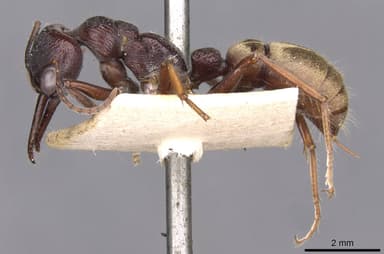
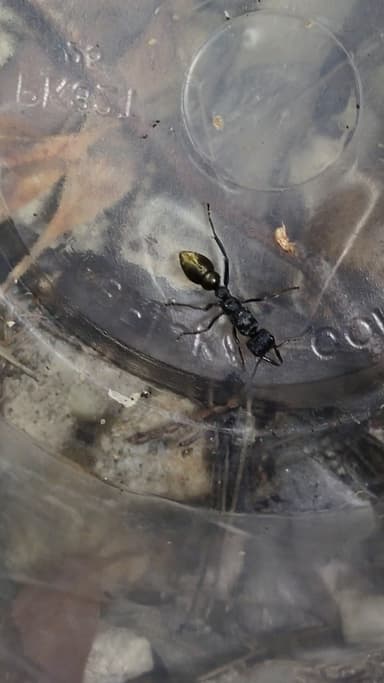
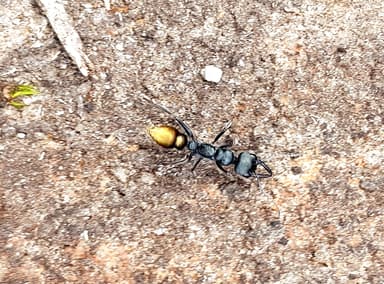
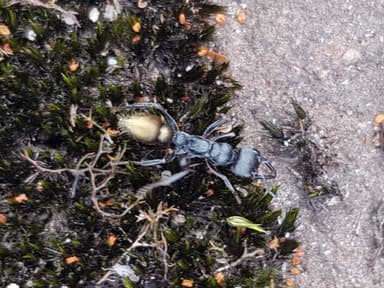
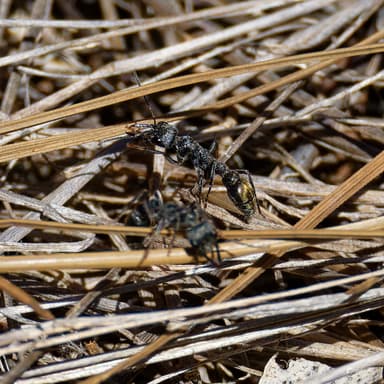
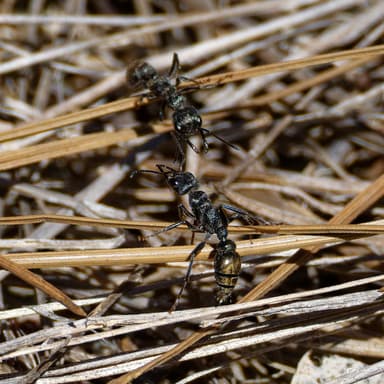
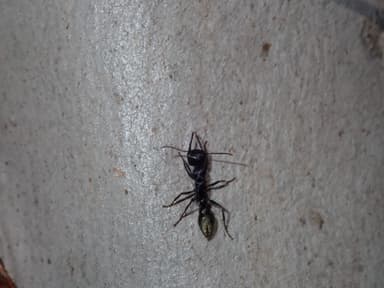
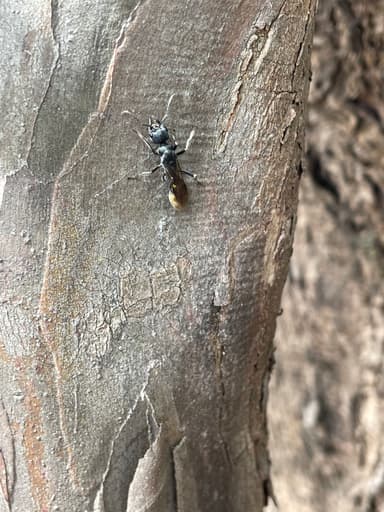
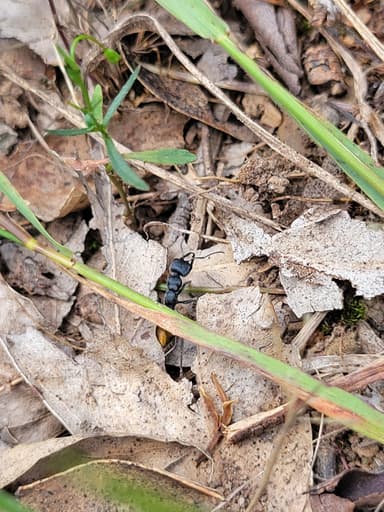
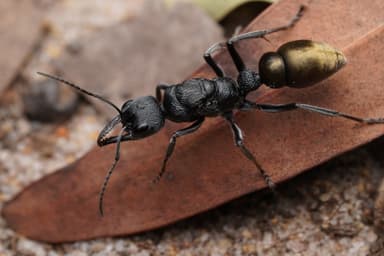
Myrmecia piliventris is a true jewel among Australian bull ants, embodying the formidable hunting prowess and distinctive visual acuity that define the genus. Queens can reach a commanding 20 to 25 millimetres, while workers span 14 to 22 millimetres, all clad in a polished black exoskeleton with golden pubescence adorning the gaster—a feature that earns it the common name “golden-tailed bull ant.” Unlike many ants that rely heavily on chemical trails, these are solitary foragers with enormous compound eyes, allowing them to spot and stalk prey over remarkable distances. Colonies are modest by Myrmecia standards, peaking at around 1,500 workers, and are founded by a single semi-claustral queen who leaves the nest to hunt during the vulnerable early stages (Ogata & Taylor 1991). The queen’s foraging trips mean you are granted a rare window into the life of a founding ant, but this very trait sets the tone for the commitment required.
Caring for Myrmecia piliventris is an undertaking reserved for expert keepers with a steady hand and a deep understanding of ant behaviour. The semi-claustral founding phase is particularly demanding: the queen must be provided with small live or freshly killed insects in a secure, stress-free outworld almost immediately, as she cannot sustain her first brood solely from metabolic reserves. Missing a single feeding can cascade into brood cannibalism or death. Beyond founding, the colony’s lightning-fast reflexes, sharp stingers, and exceptional climbing ability demand escape-proof formicaria with precisely engineered barriers, such as a fluon-coated perimeter and tight-fitting lids. This species is not for the faint-hearted or the beginner; it rewards meticulous observation and a willingness to adapt, but punishes negligence swiftly. If you have successfully kept other semi-claustral species like Myrmecia nigrocincta or large Ponerines, you may be ready for the golden-tailed bull ant.
Housing must replicate the temperate and subtropical Australian climates from which these ants hail, guided by occurrence records stretching from southern Queensland down to Victoria and across to South Australia (GBIF). Temperature is best maintained in a gradient from 18°C at night to a daytime peak around 28°C, achieved with a low-wattage heat mat placed under one corner of the nest so workers can self-regulate. Humidity should stay between 50% and 70%, mimicking the moist leaf litter and soil of their sclerophyll forest floors. For the founding queen, a simple test tube setup with a water reservoir plugged by cotton, housed inside a small foraging arena with a thin layer of sand or coco peat, works beautifully; she will appreciate a piece of bark to hide beneath. As the colony grows, a ytong or 3D-printed nest with a glass viewing panel and external hydration ports allows you to manage moisture without invading their space. Substrate in the outworld should be kept slightly damp but never waterlogged, and a few twigs or artificial plants give these visual hunters anchor points to survey their territory.
Diet is carnivore-slanted but balanced with sugars, reflecting their natural predilection for hunting. Protein sources should be insect-based: fruit flies and pinhead crickets for young colonies, graduating to small roaches, moths, and mealworm pieces as the workforce expands. All live prey must be pre-killed or disabled to prevent injuries to the queen during founding and to workers later, because an injured ant can release alarm pheromones that cause chaos in a confined space. Offer carbohydrates through organic honey, diluted maple syrup, or ripe fruit such as apple and grape, dotting tiny droplets on a piece of foil for easy removal. Always provide fresh water in a test tube or cotton-stoppered dish; these ants will drink readily. Feed a young colony small amounts three times a week, tapering to twice weekly for large colonies, and remove leftovers within 24 hours to prevent mould.
Hibernation is an absolute requirement for long-term colony health, not an optional cooling period. As the days shorten, reduce heating gradually and maintain them at a steady 12°C for two to three months, typically from late autumn into winter. During this diapause, metabolic activity slows, the queen ceases egg-laying, and workers form a motionless cluster. Keep the nest slightly less humid but never bone-dry, and offer a small water source; feeding is rarely necessary, though a tiny dab of honey in the outworld can be left if workers become active on mild days. Skipping hibernation disrupts the brood cycle, weakens the immune system, and drastically shortens lifespan, so invest in a dedicated wine cooler or cool basement space in advance.
First days after purchase are a test of restraint and precision. When your queen arrives—likely alone in a shipping tube—place her still-closed tube into the prepared setup and allow her to walk out on her own, which may take hours or even overnight. Immediately provide a droplet of honey water and a pre-killed fruit fly near the nest entrance, then cover the setup with a cloth to grant darkness and security. Resist any urge to inspect her for the first 48 hours; disturbance is the primary cause of founding failure in semi-claustral queens. After two days, offer another freshly killed insect and observe from a distance. You are looking for calm, purposeful foraging—she should venture out, seize the prey, and retreat to her brood chamber. If she ignores food or appears frantic, re-cover and wait an additional day. With patience, you will witness the quiet triumph of a golden-tailed bull ant queen laying the foundation of her dynasty.