Pogonomyrmex
Pogonomyrmex californicus
Nuptial Flight Calendar
Flight months: May, Jun, Jul, Aug
Care Guide
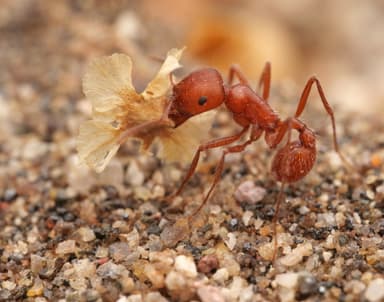
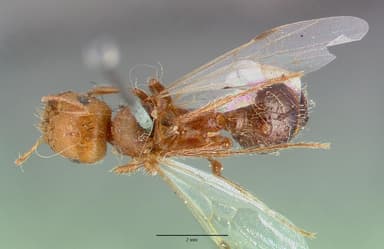
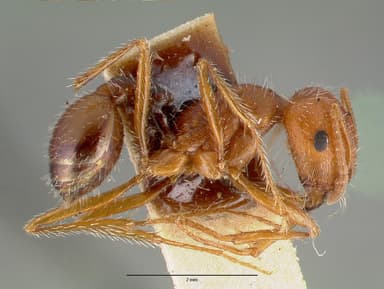
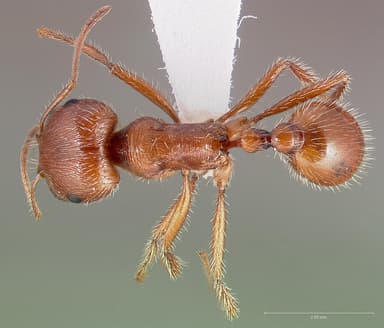
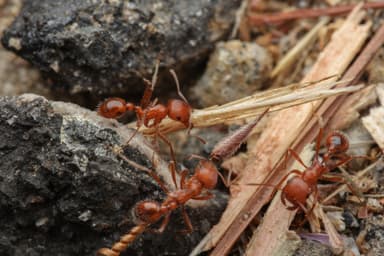
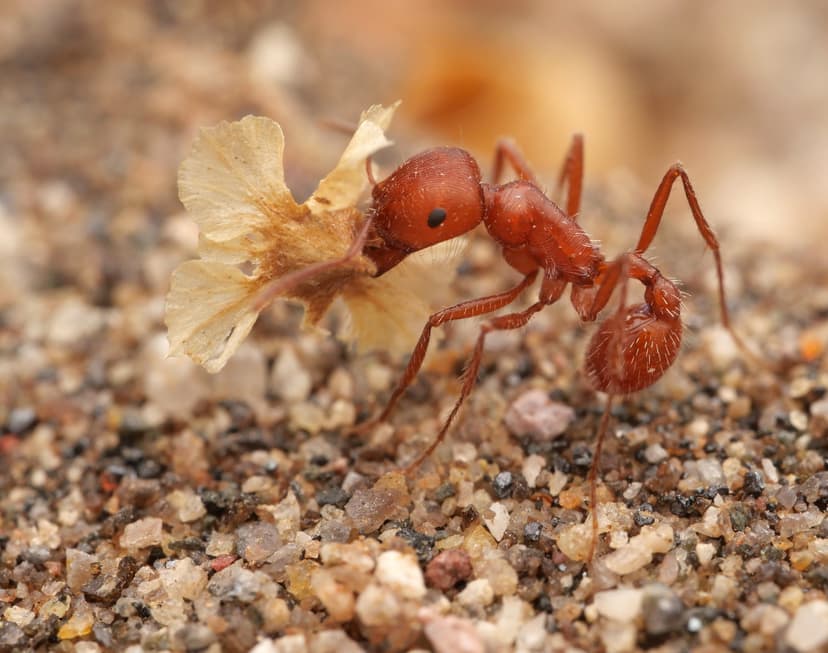
Few ants embody the American Southwest quite like Pogonomyrmex californicus, the California harvester ant. Workers measure a robust 5 to 7 millimeters, while the queen commands a queenly 9 to 11 millimeters, cloaked in a deep reddish-brown to nearly black cuticle that glints under the desert sun. Colonies are monomorphic—just a single worker caste—yet they can swell to 4,000 individuals, a formidable number for a creature that builds a conspicuous gravel-strewn mound with a meticulously cleared foraging disk. What truly fascinates observers is their granivorous economy: these are dedicated seed harvesters, and a healthy colony stores thousands of seeds in underground granaries, a behavior that has made them a model organism in behavioral ecology (Cole 1968). Their foraging columns, chemical recruitment trails, and the way workers navigate across barren soil using celestial cues all make P. californicus a living laboratory for any keeper intrigued by the complexity of ant societies. Of course, they also pack a notably potent sting—a feature that demands respect but also adds an element of awe to their husbandry.
With a care difficulty rated as intermediate, P. californicus is best suited to keepers who have graduated from their first one or two formicaria and are comfortable managing microclimates and seasonal cycles. Their sting, while not medically significant to most, is painful and can cause a welt, so escape-proof housing and deliberate handling are non-negotiable. The species is forgiving of dry conditions but suffers quickly in stagnant humidity, so it rewards a keeper who understands ventilation. Because they hibernate, you cannot skip this annual rhythm without long-term colony decline, making them a commitment that teaches seasonal adjustment. This ant is an ideal bridge between beginner species and truly demanding exotics—a desert jewel that demands attention but not constant intervention.
Housing must mirror their xeric origins. A formicarium offering a temperature gradient of 24 to 32°C is ideal, with a warm spot (around 30–32°C) that allows the queen and brood to develop optimally; ambient room temperature is perfectly acceptable for the outworld. Humidity should hover low between 30 and 50 percent, and any persistently damp nest material invites fungal outbreaks. Many successful keepers use a plaster or Ytong nest with a hydration chamber that delivers moisture from below only, letting the ants choose their preferred microclimate. Alternatively, a sand-clay or compacted loam nesting medium in a naturalistic setup mimics their wild burrows, provided you never let it become saturated. The outworld demands at least 10 centimeters of dry, fine sand or sandy soil; workers will rearrange it obsessively, sculpting miniature mounds that are a joy to watch. Good ventilation—achieved via fine-mesh screens covering generous ventilation ports—is the linchpin of the entire setup, as stagnant air rapidly leads to brood mortality and microbial growth. A small water tube or a test tube setup as a backup moisture source should always be available, but daily misting is unnecessary and often harmful.
Diet for these harvesters is predominantly seeds—creeping red fescue, dandelion, chia, and Kentucky bluegrass are all excellent choices, and they will even collect tiny amaranth. Provide a mix of small seeds in the outworld, and you will witness the full choreography of seed retrieval, husk removal in the nest, and storage. Yet despite their vegetarian reputation, P. californicus are highly responsive to insect protein: they need small portions of freshly killed fruit flies, crickets, or mealworm segments weekly, especially while a colony is raising larvae. Worker ants will process these offerings into a proteinaceous slurry for the developing brood. A dilute honey or sugar water droplet offered once a week gives adults a quick energy boost, but do not overfeed sweets—excess can turn into a sticky hazard. Water should be present at all times in a small, non-drowning feeder; however, note that these ants derive a good portion of their moisture from stored seeds and prey, so they often ignore an open water source for days.
Hibernation is non-negotiable. P. californicus requires a proper winter diapause at around 15°C for two to three months, typically from November through January. A dedicated hibernation chamber like a wine cooler is ideal, but an unheated room or a cool basement works as well, provided the temperature remains stable and never dips below 10°C. Begin the transition by gradually reducing the photoperiod and temperature over two weeks. Once in diapause, workers will huddle inside the nest, barely moving, and the queen ceases egg-laying entirely. Do not offer food during this time, but maintain a small water source—a test tube with a cotton plug prevent desiccation. Bringing them out of hibernation should also be gradual, mimicking spring; a sudden return to full warmth can shock the colony and delay recovery.
On the first days after your colony arrives, patience is your greatest tool. Place the ants in their new home with minimal light and vibration, and allow them at least 24 hours of complete darkness to settle. A founding queen still in her claustral tube will not need food for weeks, but a small colony with workers appreciates a pinch of poppy-sized seeds and a pre-killed fruit fly after the initial settling period. Watch for signs of distress: workers endlessly patrolling the perimeter indicates they haven’t accepted the nest, often due to excess moisture or a gap that feels insecure. If they cluster tightly around the queen and do not explore, the temperature may be too low. Once you see a few workers venture out, return with a seed, and disappear into the nest, you’ll know the colony has imprinted on its new territory. Remember that the nuptial flights occur in the mornings of June through August, right after summer monsoon rains in the southwestern United States, so newly mated queens are often available during those months (Johnson 2000). With the right setup and attention to their arid rhythm, Pogonomyrmex californicus will reward you with years of industrious spectacle—a tiny patch of desert engineered entirely by ants.