Pheidologeton
Pheidologeton diversus
Nuptial Flight Calendar
Flight months: May, Jun, Jul, Aug, Sep
Care Guide
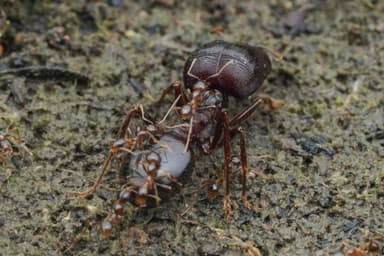
Few ants capture the imagination of a seasoned keeper quite like Carebara diversa, long known to hobbyists as Pheidologeton diversus before the genus revision by Fischer et al. (2014). This species boasts one of the most extreme examples of worker polymorphism in the ant world, with a physical caste system spanning four distinct forms. At one end, the diminutive minor workers measure a mere 1.8 millimetres, while the colossal supermajors can reach 13 millimetres in length, their massive heads packed with muscle. The queen herself is a gentle giant at 22–25 millimetres, and under her reign a mature colony can swell to over 100,000 individuals. Across its native range, which arcs across South and Southeast Asia from India to the Indonesian archipelago, these ants form long, conspicuous foraging columns. Among their most celebrated behaviours is cooperative food transport, where chains of minors and media workers drag prey many times their size back to the nest — a phenomenon famously documented by Moffett (1988). This spectacle of strength, combined with the sheer visual drama of multiple soldier castes marching alongside tiny caretakers, makes C. diversa a true jewel for the advanced myrmecologist.
Unsurprisingly, such biological extremes demand an expert keeper. This is not a species for the faint-hearted or the beginner. Colonies grow explosively, and within a year or two a thriving nest can contain tens of thousands of ants that require ever-expanding quarters, meticulous environmental control, and a constant, protein-rich food supply. Escape prevention is a non-negotiable priority; minors are small enough to slip through gaps invisible to the naked eye, and an exodus of this species can become a fast-moving tide through a household. Only keepers with a proven track record of managing large, fast-growing tropical species — and who are prepared to build custom, fortress-like formicaria — should consider taking on C. diversa. The reward is authentic: you get to witness an intricate caste system functioning in a way few captive species can rival, but the price is unrelenting vigilance.
Replicating their tropical home is the cornerstone of husbandry. Enclosures must maintain a steady temperature between 24°C and 30°C, with a relative humidity hovering between 60% and 80%. A thermal gradient is beneficial, typically achieved by placing a heat mat or cable under one portion of the nest, allowing the ants to self-regulate. The nest itself needs to be a spacious, multi-chambered structure that can accommodate a queen and her retinue now and a megacolony later. Many successful keepers opt for large ytong or plaster nests with integrated hydration galleries, which wick moisture evenly without flooding. However, a sweeping naturalistic terrarium with a deep, loamy substrate blend — sand, humus, and clay — can allow the ants to excavate as they do in the wild, provided the soil is kept properly moist. The outworld must be equally generous, with a secure, tight-fitting lid treated with a high-quality fluon or oil barrier, as workers will test every inch of perimeter. Live plants can help maintain humidity and visually anchor the display, but they must be non-toxic and sturdy enough to withstand the ants’ incessant traffic.
Diet amplifies the demands of colony size. These ants are voracious predators and scavengers. A constant supply of insect protein is critical, especially as larvae hatch in waves. Crickets, dubia roaches, mealworms, and fruit flies should form the staple diet, with larger prey items pre-killed or cut to size for easier processing by the chain-forming workers. For carbohydrates, the colony will greedily lap up diluted honey, maple syrup, or sugar water offered on a small feeding station, and many keepers supplement with ripe fruit. Water must always be available in a drinker or through the nest’s hydration system. Because of the enormous demand, expect to feed daily once the colony exceeds a few thousand workers, and be prepared to adjust portion sizes as the supermajors begin to appear — they will tackle prey that a minor could barely mouth.
A welcome reprieve in the care schedule is the complete absence of hibernation. This species hails from a climate without a cold season, so you will maintain the warm, humid parameters all year. No cooling period is needed for brood development or queen fertility; they are in perpetual motion. This year-round activity, however, means there is no off-season for upkeep — feeding, cleaning, and barrier maintenance remain constant.
When your queen and her first small entourage arrive, the transition must be gentle. Whether she is still alone in her test tube or already tending a clutch of eggs and nanitic workers, place her setup in a dark, draught-free space at a steady 26–28°C with high humidity. Resist the temptation to check on her more than once every few days. After 48–72 hours of undisturbed calm, offer a tiny dab of sugar water on a waxed paper strip and a crushed fruit fly or a gnatsized piece of pre-killed cricket. Remove uneaten protein within 24 hours to prevent spoilage. Watch for signs of normal behaviour: the queen should be calm, the brood clustered, and any workers grooming her steadily. Excessive restlessness, roaming, or neglect of brood often signals stress from vibration or unsuitable microclimate. Once the first minor workers begin foraging tentatively, you can gradually increase feedings and attach the founding tube to a small outworld to kickstart colony life. Patience here pays immense dividends — a stable foundation sets the stage for the awe-inspiring society that will unfold.