Odontoponera
Odontoponera transversa
Nuptial Flight Calendar
Flight months: Apr, May, Jun, Jul, Aug, Sep
Care Guide
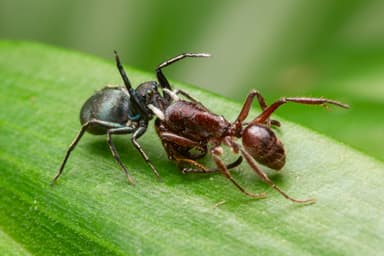
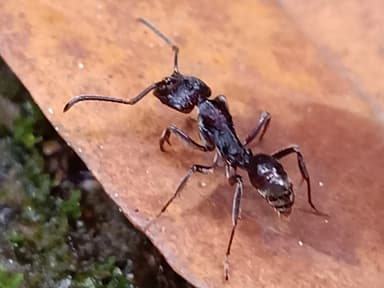
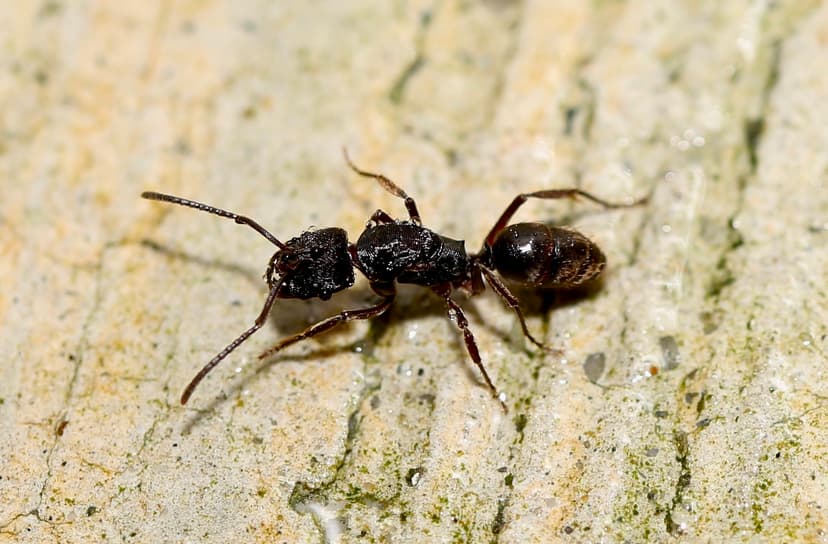
Odontoponera transversa is a formidable and captivating ponerine ant that brings a touch of the wild Asian tropics to the hobbyist's collection. Often called the "transverse-toothed ponerine," its common name hints at the distinctive mandibles that curl outward like a pair of miniature sickles, each armed with a strong basal tooth. Queens reach a robust 11 to 13 millimeters, while the monomorphic workers range from 9 to 12 millimeters, all clad in a deep, almost black exoskeleton with subtle reddish highlights on the legs and mandibles (Yamane 2009). The colony is modest by ponerine standards, eventually growing to around 1,000 individuals. What truly sets this species apart is the semi-claustral founding strategy: newly mated queens must leave their brood chambers to hunt, exposing them to the outside world in a way that fully claustral species never experience. This behavior, combined with their aggressive predatory instincts and a notoriously painful sting, makes observing an Odontoponera transversa colony an endlessly fascinating drama of survival and adaptation, never far removed from the leaf litter of its native forests spanning from India across Southeast Asia to the Philippines and Indonesia.
Categorized as a species of intermediate difficulty, Odontoponera transversa suits keepers who have already mastered the basics of ant care and are ready for a more demanding, interactive experience. The semi-claustral founding demands that you actively provide a foraging arena and regular meals right from the start, because a starving queen will fail to raise her first workers. Additionally, these ants are not shy about defending themselves; their sting is potent, and workers will rush out with jaws agape at the slightest disturbance of their nest. You will need to plan careful escapes prevention and a steady hand during maintenance. That said, their resilience to minor fluctuations in conditions is a forgiving trait for those learning the rhythms of ponerine keeping. If you enjoy feeding live prey, watching a queen hunt, and are prepared to respect a defensive colony, O. transversa offers a deeply rewarding window into a more primal style of ant life.
Housing must replicate the warm, humid microclimate of tropical leaf litter. A temperature range of 22 to 28°C suits them well; a gradient created by applying a small heat mat to one side of the nest allows the colony to self-regulate. Humidity is critical and should be maintained between 60 and 80 percent, which can be achieved by using a nest with a moist substrate layer or by regularly misting a plaster or Ytong formicarium. Many experienced keepers find that a naturalistic setup, featuring a deep soil or clay-sand mix, encourages digging and helps stabilize humidity, while still allowing for observation through a glass panel. For founding queens, a simple test-tube setup attached to a small foraging arena works beautifully—just ensure the tube has a water reservoir and that the arena substrate is kept damp. A drinking water source, such as a water feeder or a soaked cotton ball, must be available at all times. Good ventilation is essential to prevent mold, but the nest should never dry out; a balance is achieved by providing a humidity gradient, so workers can move eggs and larvae to the zone that suits their development.
Feeding Odontoponera transversa is a highlight of their care, as they are voracious and skilled hunters. Their diet consists primarily of live or freshly killed invertebrates: crickets, small roaches, mealworms, and flightless fruit flies are all eagerly seized by their toothed mandibles. Protein is especially critical for the founding queen, who will hunt tiny prey like springtails or chopped mealworm segments to fuel her egg production. Once workers are present, the colony will readily accept larger prey items. Carbohydrates should also be provided in the form of diluted honey, sugar water, or ripe fruit pieces, which the ants lap up with visible enthusiasm. Feed in small portions every one to two days during the active growth phase, removing any uneaten remains after 24 hours to prevent outbreaks of mites or mold. A separate feeding dish can help contain sticky liquids and make cleaning easier, though many keepers simply place food directly on a clean stone or piece of bark in the arena.
This is a strictly tropical species, and hibernation is not part of its annual cycle. The ants remain active throughout the year, so no cooling period is required or desired. In their native range, nuptial flights seem to occur during the monsoon months between April and September, on warm, humid evenings often following rainfall. This rhythm means that a colony kept at a steady warm temperature indoors will forage, brood, and expand continuously. You should plan for year-round feeding and maintenance without any dormant break, a schedule that some keepers find refreshingly constant but which demands consistent attention to humidity and prey availability.
When your new Odontoponera transversa queen arrives, give her the quiet, darkened space she needs to recover from transport. If you have a semi-claustral founding setup ready—a test tube with water stoppered by cotton, connected to a small arena with moist coconut coir or soil—gently introduce her and cover the arena to block out light. Within the first 24 hours, offer a tiny droplet of sugar water on a piece of wax paper and a pre-killed fruit fly or ant-sized cricket leg. Watch from a distance: a healthy queen will drink eagerly and may carry the protein back toward the tube mouth. She will begin to lay eggs within days, but she will continue to exit the tube regularly to hunt and hydrate, so never seal her into the tube alone. Check every other day to replace tiny food offerings and to mist the substrate lightly if it begins to dry. Resist the temptation to check on her too frequently, as stress can lead to brood cannibalism. After the first workers eclose, you can gradually increase prey size and enjoy the rapid development of a colony that, from its very first moments, has required your active partnership to thrive.