Harpegnathos
Harpegnathos saltator
Nuptial Flight Calendar
Flight months: Jun, Jul, Aug, Oct
Care Guide
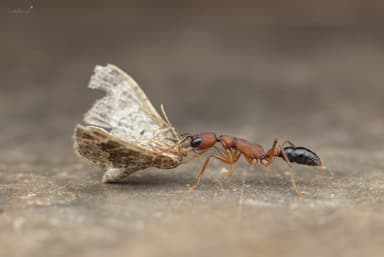
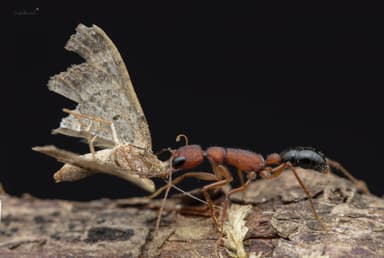
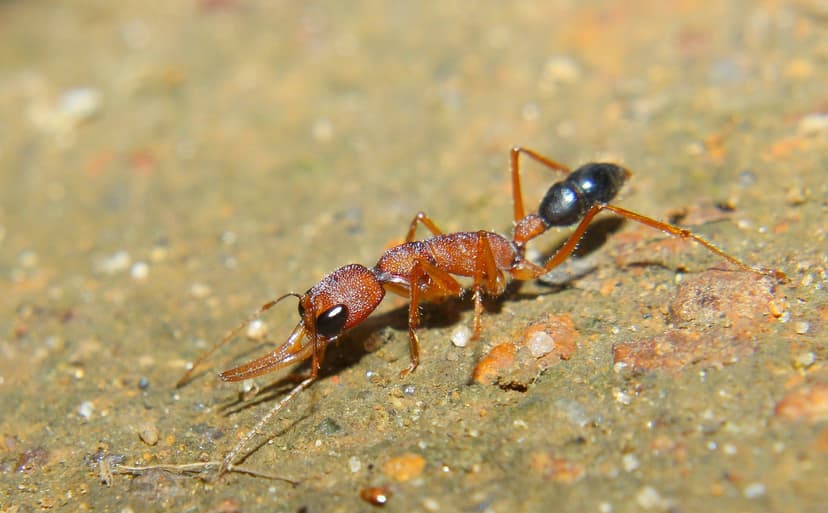
Harpegnathos saltator, often called Jerdon’s jumping ant, is one of the most visually arresting and behaviorally complex ants in the hobby. Found across South and Southeast Asia from India to Thailand, queens reach 18–22 mm while workers span 15–20 mm, both bearing slender bodies, extraordinarily long legs, and huge, forward-set eyes that give them a distinctly wasp-like appearance. Their common name comes from a remarkable ability to leap several centimeters when startled or seizing prey—an adaptation that pairs with a powerful sting to subdue live insects. Colonies are small, rarely exceeding 300 individuals, yet their social structure is anything but simple. Alongside typical minor workers, the species produces ergatoid reproductives: mated, egg-laying workers known as gamergates. When a founding queen ages or dies, one or more workers can assume the reproductive role, and in many captive colonies gamergates entirely replace the queen, a phenomenon documented in classic studies by Peeters & Hölldobler (1995) and Liebig et al. (1999). This reproductive plasticity, driven by neuropeptide shifts (Penick et al. 2012), makes H. saltator a living laboratory for social evolution.
Care difficulty is unambiguously expert, and the species is best reserved for keepers who have already mastered more forgiving ants. The foundational challenge is semi‑claustral founding: a newly mated queen must leave her brood chamber to hunt, so she cannot simply be sealed in a test tube and forgotten. She requires a small foraging arena from day one, with live prey offered every one to two days. Beyond founding, the ants’ agility and escape potential demand meticulously secured enclosures—a leaping worker can clear a gap that would trap any ordinary ant. Their sting, though not medically significant to most people, is intensely painful and can cause swelling, so careful handling is a must. Only those equipped to provide frequent live feedings, stable high humidity, and close observation will find this species rewarding. In return, you’ll witness astonishing predatory leaps and the rare chance to observe a society where any worker might one day become a queen.
Housing must balance a tropical microclimate with security and burrowing opportunity. A glass or acrylic nest with a deep (10 cm or more) humidity‑retaining substrate is ideal; mixtures of soil, clay, and sand allow the ants to excavate chambers while resisting collapse. Temperature should range from 22 °C at the cool end to a warm spot of 30 °C, easily provided with a heat mat or cable placed under one side of the nest. Humidity needs to stay between 60% and 80%—achieved through regular misting or a water‑fed hydration layer in ytong or plaster nests—while ventilation must be sufficient to prevent mold. An outworld with a securely fitted, fine‑mesh lid and a barrier of fluon or talcum oil is non‑negotiable. Many keepers add twigs and crumpled leaf litter both as climbing surfaces and to trigger natural hunting sequences. For founding queens, a simple test tube setup with a water reservoir, opened into a tiny outworld, works best; once workers number a dozen or more, they can be moved to a permanent nest via a connective tube, allowing them to shift at their own pace.
The diet of H. saltator is almost exclusively carnivorous, with hunting serving as both nutrition and enrichment. Offer a variety of live insect prey—crickets, roaches, mealworms, and fruit flies for younger colonies—every day or every other day. These ants will stalk, leap, and sting their victims, so leaving prey unrestrained (though not large enough to injure the ants) triggers the most natural behavior. A small drop of honey or sugar water offered once a week provides carbohydrates, and a constant source of fresh water, either in a test tube or a cotton‑plugged water dish, is essential. Remove uneaten prey within 24 hours to prevent decay and mite outbreaks. Semi‑claustral queens need particular attention: present her with a freshly killed or moribund cricket pinhead or fruit fly every day during founding; once the first workers emerge, they will take over hunting duties.
No hibernation period is required, as H. saltator is native to year‑round warm climates with only marginal seasonal cooling. Maintain stable temperatures and humidity throughout the year without a winter rest. Any attempt to artificially cool the nest can stress the colony and disrupt brood development.
Upon receiving your new colony or founding queen, the first days are critical. If starting with a mated queen in her test tube, place the tube in the prepared outworld and open the cotton plug, then retreat and give her at least 24 hours of silence and low light. Offer one tiny drop of honey on a piece of wax paper and a small, pre‑killed insect near the tube entrance the following evening. Check discreetly to see if she has fed; if not, replace the food the next night. Disturbances should be kept to an absolute minimum—do not shine bright lights on her or tap the enclosure. Workers and gamergates in an established colony may be skittish initially; they might huddle together without venturing out for a day or two. This is normal. Watch for the queen or gamergates to begin laying eggs within a week, signaled by a small cluster of pale, slender eggs tucked into the nesting material. Once you see regular foraging and brood care, you can incrementally increase observation time, but always with the knowledge that a few of these extraordinary ants are watching you right back.